☎ Call Now: +40 2344 9000

◷ Available: Mon. – Fri 12am to 12pm

PROFESSIONAL UNDERGROUND PROTECTION

Basement Waterproofing in Karachi

Inspection-led solutions for basement wall seepage, floor leakage, cracks and groundwater moisture

Basement walls and floors remain in direct contact with surrounding soil, making them vulnerable to groundwater moisture, cracks, weak construction joints and leakage around pipe openings.

Pak Chemical Services inspects the direction of water pressure, concrete condition, external access and the true moisture source before recommending internal, external or localized treatment.

• BASEMENT WATERPROOFING KARACHI

Professional Basement Leakage Inspection and Waterproofing

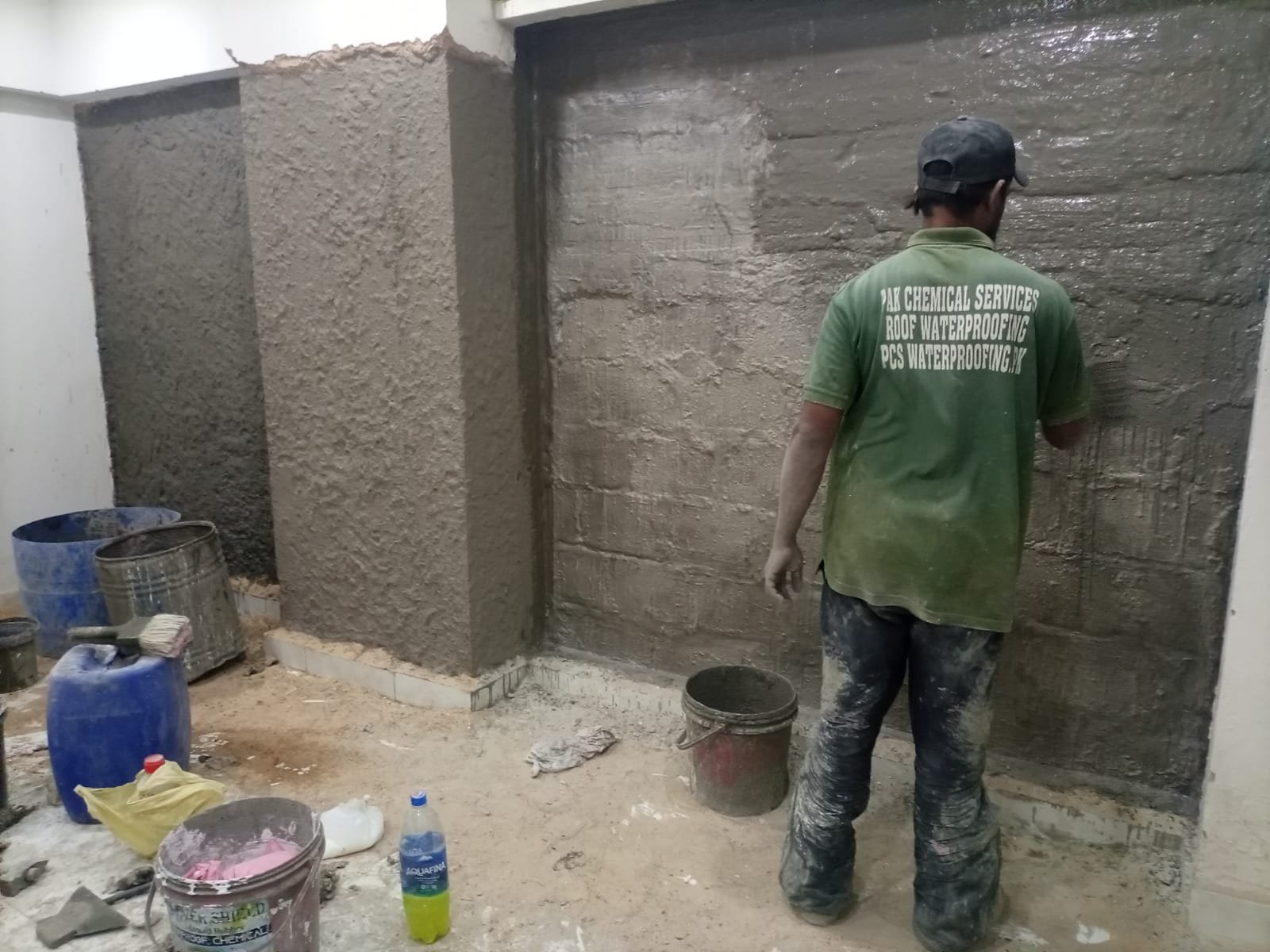
Professional Basement Waterproofing in Karachi involves treating underground walls, floor slabs, cracks, joints and pipe penetrations to control water or moisture entering from surrounding soil.

A damp basement may be affected by groundwater pressure, soil moisture, concrete cracks, wall-floor junctions, construction joints, pipe penetrations, failed waterproof coating, poor external drainage, plumbing leakage or condensation.

Not every damp patch confirms a waterproofing failure. A concealed water pipe, drain connection or ventilation issue can produce similar signs. The source should be assessed before coating or repair work begins.

The selected method may involve localized crack repair, internal waterproofing, external membrane treatment or a combination based on the site condition.

• EARLY WARNING SIGNS

Common Signs of Basement Water Seepage

Basement leakage may appear as active water entry, but many properties first show gradual moisture damage. Salt deposits, also known as efflorescence, can appear when moisture passes through masonry or concrete and leaves mineral residue behind. A musty smell or peeling paint alone does not prove groundwater entry; condensation, plumbing leakage and poor ventilation should also be considered.

Damp patches on basement walls

A condition to document and assess during the basement inspection.

Moisture along the floor perimeter

A condition to document and assess during the basement inspection.

Water appearing after rainfall

A condition to document and assess during the basement inspection.

Standing water near corners

A condition to document and assess during the basement inspection.

White salt deposits on concrete

A condition to document and assess during the basement inspection.

Peeling or blistering paint

A condition to document and assess during the basement inspection.

Damaged plaster

A condition to document and assess during the basement inspection.

Musty smell

A condition to document and assess during the basement inspection.

Dark marks near wall-floor joints

A condition to document and assess during the basement inspection.

Water around pipe openings

A condition to document and assess during the basement inspection.

Cracks with visible moisture

A condition to document and assess during the basement inspection.

Repeated failure of previous repairs

A condition to document and assess during the basement inspection.

Dampness returning after repainting

A condition to document and assess during the basement inspection.

Concrete surface deterioration

A condition to document and assess during the basement inspection.

Moisture spreading across stored items

A condition to document and assess during the basement inspection.

• FIND THE SOURCE FIRST

What Causes Basement Leakage?

Groundwater and Soil Moisture

Basement walls remain in contact with surrounding soil. Rainfall, drainage and groundwater can increase moisture around the structure. Water may move through porous concrete or weak joints; increased leakage after rain can indicate rising soil moisture, but the exact source still requires inspection.

Cracks in Basement Walls and Floor

Concrete can crack because of shrinkage, settlement, movement, poor curing or age. Crack width, depth and movement determine treatment. Coating over an active or unprepared crack may only hide it temporarily. Significant structural cracks may require a qualified engineer.

Weak Wall-to-Floor Joints

The wall-floor junction is a common leakage point because surfaces may be poured at different times. Ordinary cement filling may fail when the joint remains weak or moves. Treatment may need to extend across both wall and floor.

Construction Joints

Cold joints, old-to-new concrete junctions, retaining-wall joints, separate pours, wall extensions and floor-slab transitions can transmit moisture. Moving joints may need a more flexible treatment than stable cracks.

Pipe Penetrations

Water pipes, drains, electrical conduits, utility sleeves, AC lines and service connections create openings through concrete. Poor grouting, movement or damaged sealant can admit water. The pipe itself must also be checked for plumbing leakage.

Failed Previous Waterproofing

Old coatings may fail due to weak preparation, trapped moisture, loose plaster, incompatible products, thin application, untreated cracks, weak joints, incorrect curing or later construction damage. Failed material may need removal before recoating.

Plumbing Leakage or Condensation

Not every damp basement needs waterproofing. Concealed pipe leakage, faulty drains, AC condensation and poor ventilation can create similar symptoms. These possibilities should be ruled out before groundwater treatment is recommended.

• CHOOSE BY ACCESS AND PRESSURE

Negative-Side vs External Basement Waterproofing

Negative-Side Waterproofing

Applied from inside the basement, opposite the side from which water enters. It may be considered when external walls are inaccessible, the basement is already constructed, excavation is impractical, moisture is visible internally, and cracks or joints can be reached from inside.

  • Remove loose paint, weak plaster and salt deposits
  • Control active leakage before main coating
  • Prepare the concrete carefully
  • Recognize that not every pressure condition can be solved from inside

External Waterproofing

Applied to the outside face of underground walls and addresses moisture before it enters the wall. It may be suitable during new construction, where external access or excavation is practical, the retaining wall is exposed, and drainage or protective layers can be installed.

  • Review neighbouring structures and paving
  • Check landscaping and buried utilities
  • Plan drainage and protection before backfilling
  • Select internal or external treatment by site condition
• TARGETED OR COMPLETE TREATMENT

Basement Wall and Floor Leakage Repair

Basement wall and floor leakage repair may involve localized treatment or complete surface waterproofing.

  • Concrete crack repair
  • Wall-floor joint sealing
  • Construction-joint treatment
  • Pipe-penetration sealing
  • Failed coating removal
  • Active leak control
  • Damaged surface repair
  • Internal waterproof coating
  • External membrane treatment where accessible

A single leaking crack may only need targeted repair. Widespread dampness, recurring salt deposits or moisture across several walls may require broader preparation and coating. Localized sealing should not be presented as a complete solution when the surrounding surface has widespread moisture penetration.

• INSPECTION-LED WORKFLOW

Our Basement Waterproofing Process

Every stage is adapted to the leakage source and site condition rather than applying the same product to every basement.

Moisture Inspection

Inspect walls, floor perimeter, corners, joints, cracks, pipe openings, salt deposits, previous coating, standing water, damaged plaster, ventilation and nearby plumbing; also note whether moisture worsens after rain.

Leakage Source Assessment

Review moisture direction, active points, external ground level, rainfall changes, transitions, plumbing, drainage, condensation and external access to separate localized leakage from general dampness.

Surface Preparation

Remove loose paint, damaged plaster, salts and weak concrete; open suitable cracks; clean joints and penetrations; control the area and create a stable bonding surface.

Active Leak Control

Where water is entering, use a compatible method for the flow, pressure, crack type and substrate. This may include local crack or joint plugging, pipe-opening treatment and fast-setting repair material.

Crack and Joint Repair

Treat stable cracks, movement-prone joints, wall-floor junctions, construction joints, pipe penetrations and selected concrete patches before the broader layer. Structural cracks may need specialist assessment.

Waterproofing Application

Apply required primer, compatible cementitious or internal coating in multiple coats, reinforce selected corners, integrate repairs and use an external membrane where access allows.

Curing and Final Testing

Follow curing requirements for product, coat count, moisture, temperature, humidity, repair thickness and ventilation. Check coverage, active seepage and weak edges, including observation after rainfall where appropriate.

• CONSTRUCTION-STAGE PLANNING

New Construction vs Existing Basement Waterproofing

New construction provides greater access to the outside of basement walls. Waterproofing can be integrated with retaining walls, wall-floor joints, cold joints, pipe sleeves, floor slabs, external drainage and protective layers before backfilling.

Existing basements often require internal access because external walls may already be covered by soil or adjoining construction. Existing Basement Waterproofing in Karachi may involve negative-side treatment, removal of failed finishes, crack and joint repair and localized leak control. Installed services, finished floors and use of the space can affect scope.

• SUPPORTING MEASURES WHEN NECESSARY

When Drainage or Dewatering May Be Required

Waterproof coating alone may not be sufficient where water continues accumulating around the basement.

  • Water stands outside retaining walls
  • Excavation contains active water
  • Leakage pressure remains high
  • External drains are blocked
  • Ground levels direct water toward the building
  • Treatment surface cannot remain suitable for application
  • A sump or pumping arrangement is required

Possible supporting measures include improving external drainage, correcting site grading or temporarily pumping water during work. These are included only when inspection confirms they are necessary and available—not advertised as a standalone PCS service.

• UNDERGROUND SPACES

Basement Areas We Inspect and Treat

The final scope depends on building type, access, water source and the condition of each surface.

Internal basement walls

Included where inspection confirms treatment is required.

Retaining walls

Included where inspection confirms treatment is required.

Floor slabs

Included where inspection confirms treatment is required.

Wall-floor junctions

Included where inspection confirms treatment is required.

Construction joints

Included where inspection confirms treatment is required.

Concrete cracks

Included where inspection confirms treatment is required.

Pipe penetrations

Included where inspection confirms treatment is required.

Drain surroundings

Included where inspection confirms treatment is required.

Stairwell walls

Included where inspection confirms treatment is required.

Storage areas

Included where inspection confirms treatment is required.

Service rooms

Included where inspection confirms treatment is required.

Parking basements

Included where inspection confirms treatment is required.

External walls where accessible

Included where inspection confirms treatment is required.

• PROFESSIONAL TREATMENT

Benefits of Professional Basement Waterproofing

Better identification of the moisture source

A practical benefit of correct inspection, preparation and treatment.

Reduced wall and floor seepage

A practical benefit of correct inspection, preparation and treatment.

Repair of cracks and joints

A practical benefit of correct inspection, preparation and treatment.

Better protection of internal finishes

A practical benefit of correct inspection, preparation and treatment.

Reduced repeated repainting

A practical benefit of correct inspection, preparation and treatment.

Better control of salt deposits

A practical benefit of correct inspection, preparation and treatment.

Separation of plumbing and groundwater issues

A practical benefit of correct inspection, preparation and treatment.

More suitable internal or external treatment

A practical benefit of correct inspection, preparation and treatment.

Clear curing guidance

A practical benefit of correct inspection, preparation and treatment.

Improved usability of basement space

A practical benefit of correct inspection, preparation and treatment.

Reduced moisture spreading to nearby surfaces

A practical benefit of correct inspection, preparation and treatment.

No treatment is described as permanently effective without considering water pressure, structural movement, drainage, maintenance and surrounding building condition.

• INSPECTION BEFORE QUOTATION

Basement Waterproofing Cost in Karachi

The cost of Basement Waterproofing in Karachi depends on the affected area and required treatment.

  • Basement size and affected walls
  • Floor area and access
  • Active leakage, cracks and joints
  • Pipe penetrations
  • Old coating and damaged surfaces
  • Material system and number of coats
  • Excavation, drainage or dewatering
  • Ventilation, curing and testing

Two basements of the same size can have different costs. One may need localized repair while another requires complete surface preparation and full-wall treatment. A site inspection provides a more reliable quotation than a fixed square-foot rate.

• PAK CHEMICAL SERVICES

Why Choose Pak Chemical Services?

Pak Chemical Services follows an inspection-led approach. We do not assume every damp basement requires the same coating. Warranty, expected treatment life and drainage work are defined only in the written quotation.

Identifying the moisture source

Part of our site-specific basement waterproofing workflow.

Checking water-pressure direction

Part of our site-specific basement waterproofing workflow.

Inspecting walls, floors and joints

Part of our site-specific basement waterproofing workflow.

Separating groundwater from plumbing issues

Part of our site-specific basement waterproofing workflow.

Reviewing external access

Part of our site-specific basement waterproofing workflow.

Removing weak surface material

Part of our site-specific basement waterproofing workflow.

Selecting treatment by site condition

Part of our site-specific basement waterproofing workflow.

Providing a clear project scope

Part of our site-specific basement waterproofing workflow.

Following material-specific curing

Part of our site-specific basement waterproofing workflow.

Completing final inspection

Part of our site-specific basement waterproofing workflow.

Recommending specialist assessment where necessary

Part of our site-specific basement waterproofing workflow.

• COVERAGE ACROSS THE CITY

Basement Waterproofing Services Across Karachi

Customers can share basement photographs, damp-wall images, floor-joint pictures and their location through the existing PCS contact channel. Photos support the initial discussion, but physical inspection may still be necessary.

DHACliftonGulshan-e-IqbalGulistan-e-JoharPECHSNazimabadNorth NazimabadKorangiSaddarSITE AreaNearby Karachi locations
• USEFUL LINKS

Related PCS Services

Services

Explore all PCS waterproofing solutions.

Roof Waterproofing

Professional roof waterproofing services in Karachi.

Contact Pak Chemical Services

Request an inspection for your property.

• QUESTIONS ANSWERED

Frequently Asked Questions About Basement Waterproofing

Why does a basement wall become damp?
• GET IN TOUCH

Request a Basement Inspection in Karachi

Basement moisture can enter through cracks, joints, pipe openings or porous concrete, but similar dampness can also result from plumbing leakage or condensation.

Contact Pak Chemical Services for Basement Waterproofing in Karachi. Share your location, basement photographs and visible leakage details to request an inspection and quotation.